I picked up Big Magic by Elizabeth Gilbert months ago. I read it a bit when I first acquired it, but, while I enjoyed it, the book was not grabbing me. This is in part because it is a book that wants to be read in snatches. I want to read a few sections and think about them. Unfortunately this leaves me time to get distracted and forget to come back to the book. Also there is the fact that I don’t completely agree with the ways that Gilbert views creativity. I’ll be reading along and feeling in rapport with the text, but then hit a sentence or a paragraph where I want to argue “No, it’s not quite like that.” Her viewpoint isn’t invalid, it just makes me want to discuss with her, except that she isn’t here to speak to, just the book, and books aren’t good at listening. So I wandered away from the book for several months.
I guess I just hadn’t hit the right section of the book yet. I picked the book up again yesterday and found passage after passage that I underlined and bookmarked. One section in particular I’ve been turning over in my head ever since I read it.
“I never wanted to burden my writing with the responsibility of paying for my life. I knew better than to ask this of my writing, because over the years I have watched so many other people murder their creativity by demanding that their art pay their bills.” Elizabeth Gilbert, Big Magic
I had never before considered creation from this perspective, as if it were a shining and joyful thing that I get to support. I’d somehow assumed that my writing paying my bills was the goal. And it is, in a way, but not at all in another. I want my art to be able to support itself. I want it to be able to pay for the time it takes away from bill paying activities. I also want it to be valued and people do not value things that they do not pay for. I am fortunate. The job that pays my bills sometimes gives me creative joy, which is more than some people ever get. But my personal creative works, this blog, my short stories, the picture books, they all cost more in time and money than they have returned in money. They’ve given me many things and allowed me to give many more, but they aren’t lucrative. Gilbert’s quote reminded me that this is in no way a failure. Just as the point of raising children is not for them to support me later, the things I write do not have to support me to prove their worth. What I write has value both to me and to others who get to consume it. Creation adds to the world. That is worth pouring time, energy, and money into without expectation of financial return.
Of course there is nothing wrong with wanting to be a full-time creator. Howard is one, and in a way, so am I, though many of my hours are spent on administrivia. We have lots of friends who are full-time in their creative careers. But I think that many of those who long to go full time, don’t realize that being a full time creative person doesn’t mean more time spent creating. No one gets to write day after day without interruption. The more that your creation earns, the more it comes with obligations to publishers, fans, events, etc. Every single creator I know—both full time and part time—laments that they don’t have enough time to be creative. Gilbert’s words helped me see it. She says it outright in another section of her book.
“For most of human history, the vast majority of people have made their art in stolen moments, using scraps of borrowed time—and often using pilfered or discarded materials to boot.” Elizabeth Gilbert, Big Magic
If everyone struggles to make space in their lives to create, then why is being full-time creator always assumed to be the dream? For those who have the skills and enjoy the business aspects of a creative career, then yes it is a dream job. There are those who are invigorated by the challenges of freelance work. But there are also people who have much to give to the world and who are happier when they have a steady paycheck. There is nothing wrong with having a day job you love and a part-time creative career that you also love. There is much to be admired in art that is squeezed into the nooks and crannies of daily responsibility. Not just that, but daily responsibilities are often dismissed as mere chores without recognizing the myriad ways that chores create order out of chaos, beauty where there wasn’t any before. Many daily responsibilities are hugely creative and worth the center space they take in our lives.
As an example, I give you our postman. He has been delivering mail to our house for fifteen years now. He’s retiring this week, and messages have been posted in neighborhood Facebook groups about this fact. It was amazing to me how many people responded and had stories about this him, about his kindness in bringing mail to the door of those for whom walking to the curb was difficult. About how he knew when a family had suffered a death and helped to sort out the junk mail to ease the pain of that passing. I know that when we had big shipping events which piled up hundreds of packages for him to carry away, he always smiled and was cheerful about doing so. Such small things, just a tiny bit of extra kindness and service, what a beautiful gift he made out of his ordinary daily work. He will be missed, but hopefully he’ll have a lovely retirement where he’ll get to do some new beautiful thing.
I need to own all of my work and creativity, rather than feeling like the parts of my life are doing battle. Yes I prefer writing to shipping packages, but shipping packages feeds my family. With the family fed, my mind and heart are free to go play with words. And I can recognize that the packages I ship are received with happiness when they arrive. I get paid to send couriered joy to others. That is an amazing job to get to have. I will not complain if at some point in the future my writing does begin to help pay for my life, but it is fine if it never does. To quote another wise woman, my sister:
“Either the money will come, or it won’t. Until then I’m just going to keep doing this thing that I love.” Nancy Fulda

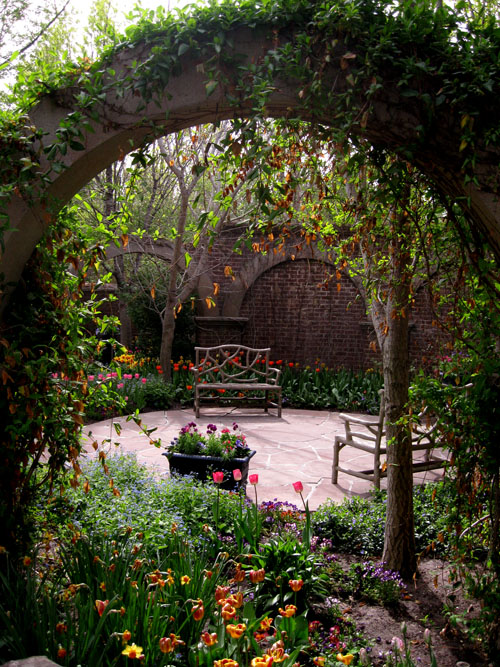
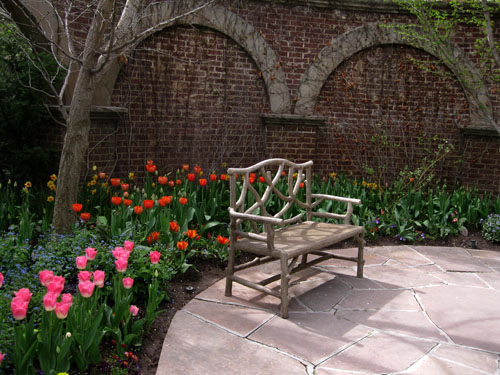
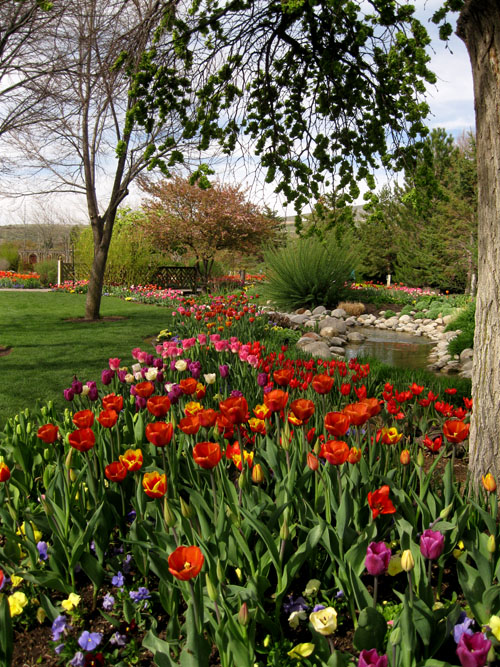
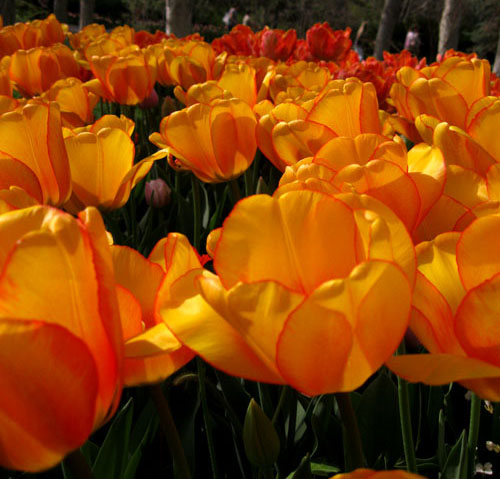
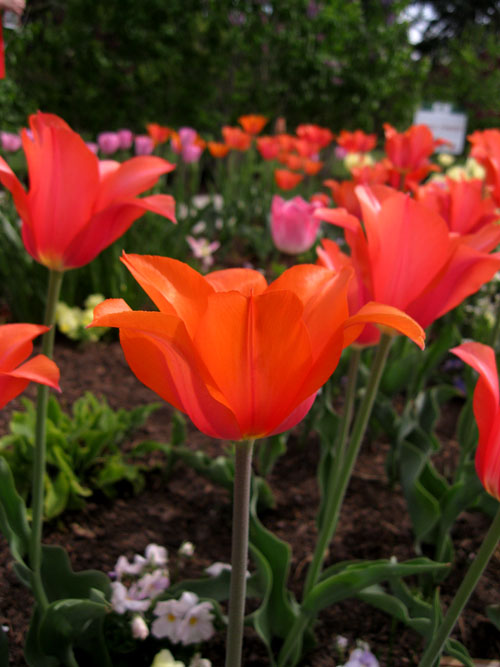
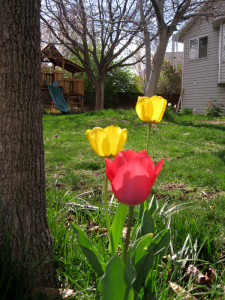 I’ve had tulips for as long as I’ve owned this house (18 years and counting). There was an abundance of them in the front flowerbed the first spring after I moved in. The thing with tulips is that most varieties of them will only come back for a few years before dying out. There are a few exceptions, mostly in bright yellow and solid red. Over the years I’ve dug up beds, redistributed tulip bulbs, bought new bulbs, and generally been a disturber of the earth. Some years I tend my flowers. Other years only the fittest will survive the incursion of weeds and neglect. Yet I’ve always had yellow tulips because they persistently grow and spread. One patch will die out, but another will thrive. In my backyard, yellow tulips are the only ones I have because I’ve not taken time to re-plant other colors. Except this spring I looked out my back window and saw a surprise. Pink tulips in my backyard flower beds. There are three of them in three different places and I don’t know how they got there. I’ve never seen pink in the back garden before. I know I didn’t do any planting last fall.
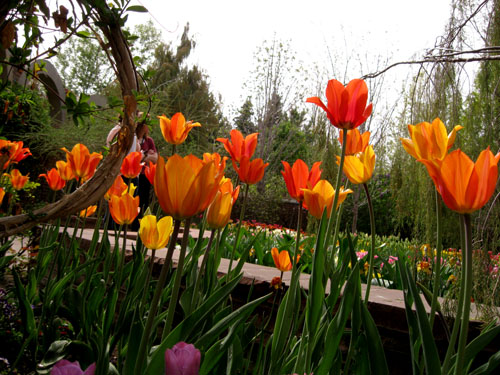
 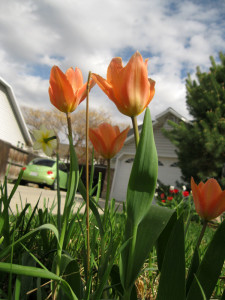 This is one of the things I love about seeing my garden year after year. It always changes. There is always some surprise or a new manifestation. This trio of apricot-colored tulips used to be giant and in classic tulip shape. Yet this year they are small and airy. It probably means that in another year or so they’ll vanish as tulip varieties so often do. Then I’ll plant some other tulip in that spot, or perhaps the lilies will take over. Each spring my flowerbeds change. They are different than the year before.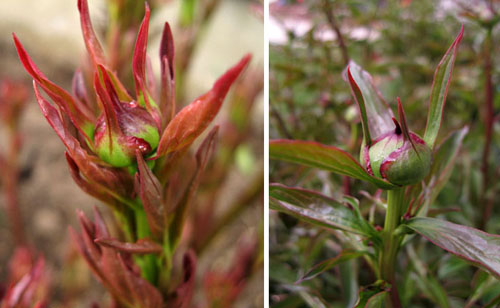
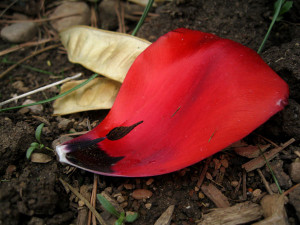 I wish that the serendipity of unexpected beauty were as easy to see as in my garden. I wish that emotional growth and development in my children were as simple to spot and photograph as the buds of my flowers. I wish that life made it easier to see that sad things sometimes have to happen because without them future happiness can’t be. I wish these things, but for now I’ll walk my flower beds and feel that the sorts of things I see there are happening in other parts of my life as well. Life is full of beautiful growth, but I won’t see it unless I stop and pay attention.
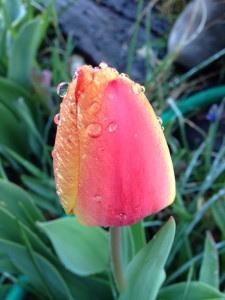 In April the fact of spring becomes obvious. This makes my heart happy. Yet I have a habit of being tangled up inside my own head and failing to notice the world around me. This is particularly true since I don’t have to leave my house to go to work. There was one year where I looked up at the beginning of May and realized that I had completely missed daffodil and tulip season. This year I plan to pay attention. The world is full of small beautiful things that exist whether or not I take time to see them, but my life is enriched when I take time to notice. And some of them do get more beautiful for my attention. The flowers in my gardens grow stronger, bigger, more beautiful when I take time to pull weeds and scatter fertilizer.